

Core FIRE Formula
Financial Independence is mathematically achieved when passive investment returns perpetually exceed ongoing annual living expenses. Under the standard 4% rule, your target portfolio requirement is exactly 25 ×Your Annual Expenses.
1. The Mathematics of FIRE and the 25x Rule
The time required to reach financial independence depends almost entirely on your household net savings rate:
| Savings Rate (% of Net Income) | Annual Spend (% of Income) | Working Years to FIRE (Starting from $0 @ 7% Real Return) |
|---|---|---|
| 10% | 90% | 51.4 Years |
| 25% | 75% | 31.9 Years |
| 50% | 50% | 16.6 Years |
| 65% | 35% | 10.5 Years |
| 75% | 25% | 7.1 Years |
2. The Trinity Study: Empirical 100-Year Backtests
The 1998 Trinity Study demonstrated that an initial 4.0% withdrawal rate adjusted annually for inflation achieved a 98% survival rate over 30-year retirement horizons when holding a 75% stock / 25% bond allocation across US historical market cycles since 1926.

3. Sequence of Returns Risk (SRR)
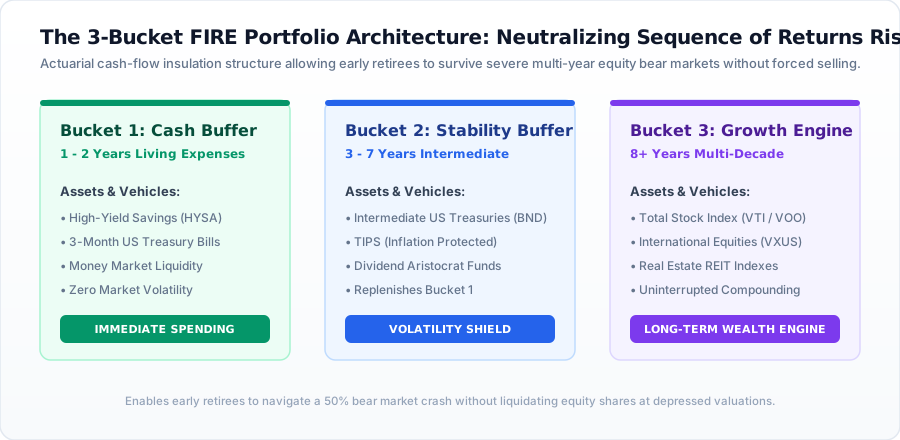
Suffering a sharp market drawdown during the first 3 to 5 years of decumulation forces retirees to liquidate equities at low prices. To mitigate sequence risk, quantitative planners recommend maintaining a 2 to 3-year cash or short-term Treasury buffer or adopting a rising equity glidepath during early retirement.
4. The Four FIRE Archetypes Compared
| FIRE Strategy | Target Annual Spend | Required Portfolio (25x) | Primary Characteristics |
|---|---|---|---|
| Lean FIRE | $25,000 - $40,000 | $625,000 - $1,000,000 | Minimalist lifestyle, geo-arbitrage, frugal baseline |
| Standard FIRE | $50,000 - $80,000 | $1,250,000 - $2,000,000 | Comfortable median lifestyle, fully funded decumulation |
| Fat FIRE | $120,000 - $250,000+ | $3,000,000 - $6,250,000+ | Abundant lifestyle, extensive travel, private healthcare |
| Barista / Coast FIRE | $30k investments + $30k work | $750,000 + Part-Time | Semi-retirement funded partially by passion work |
5. Tax-Efficient Drawdown Ordering
Liquidate taxable brokerage accounts first while harvesting capital gains at the 0% federal tax bracket, followed by strategic traditional IRA Roth conversion ladders, preserving tax-free Roth IRA and HSA assets for late-stage compounding.
6. Dynamic Guyton-Klinger Guardrails
Applying dynamic spending guardrails allows retirees to start with an initial 5.0% withdrawal rate, adjusting discretionary spending by 10% during significant bull or bear market extremes while maintaining a 99%+ survival probability.
Frequently Asked Questions
What is the 4% rule and how was it derived?
The 4% rule originated from the 1998 Trinity Study, which evaluated stock and bond portfolio survival across rolling 30-year historical periods since 1926. Withdrawing 4% in year one and adjusting for inflation annually resulted in a 98% success rate in maintaining principal.
Should early retirees use a lower withdrawal rate?
For early retirement horizons of 40 to 50 years, empirical research recommends an initial safe withdrawal rate between 3.25% and 3.5%, or utilizing dynamic guardrails to adjust spending during major market drawdowns.
How can Sequence of Returns Risk be prevented?
Sequence risk is mitigated by maintaining a 2 to 3-year cash or short-term Treasury buffer, adopting a rising equity glidepath, or using flexible spending guardrails during the first five years of retirement.